 Language


Changing your IP address is useful for web scraping, market research, and location-based data collection. However, websites can evaluate much more than an IP address.
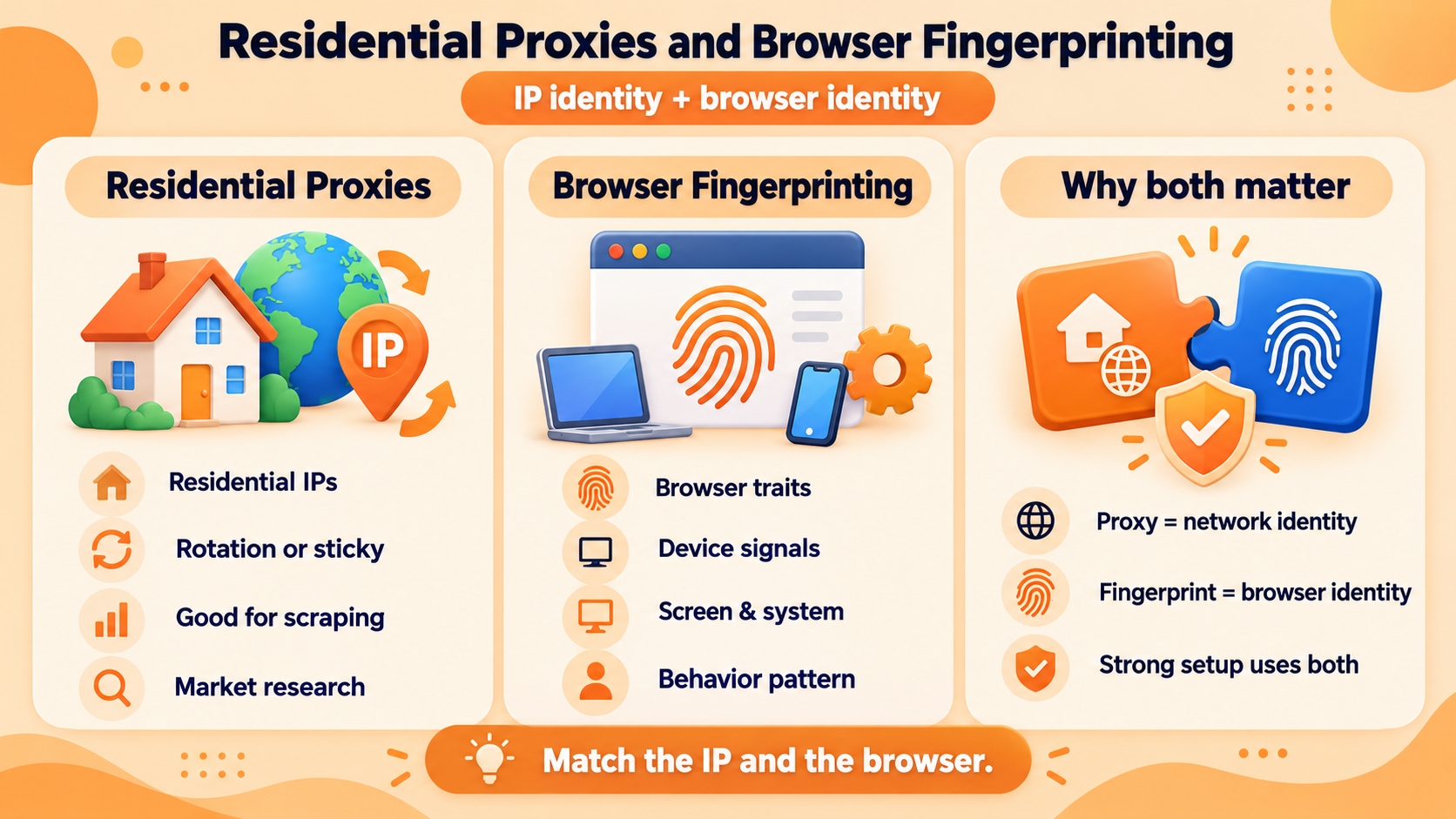
Browser fingerprinting analyzes signals such as browser version, operating system, timezone, language, screen resolution, fonts, Canvas, and WebGL data. These characteristics can remain unchanged even when a proxy assigns a new IP.
This creates an important distinction for proxy users: IP rotation changes the network identity, but it does not automatically change the browser fingerprint.
What Is Browser Fingerprinting
Browser fingerprinting combines multiple browser and device signals into a recognizable profile.
Unlike cookies, it does not always depend on information stored in the browser. Websites can compare these signals across sessions and identify recurring patterns, even when the IP address changes.
For web scraping and browser automation, this means a new proxy IP does not necessarily create a completely new browsing identity.
Does a Proxy Change Your Browser Fingerprint
A proxy replaces your original IP address and routes traffic through another network location. It does not automatically change browser-level information such as timezone, language, screen settings, or WebGL data.
For example, a browser may connect through a US residential proxy while reporting settings associated with another region. These inconsistencies can become part of the overall request profile.
For more reliable automation, proxy location, browser configuration, and session behavior should be managed together.
Residential Proxies and Browser Fingerprinting
Residential proxies use IP addresses associated with residential networks, making them useful for web scraping, price monitoring, market research, and localized data collection.
RapidProxy Residential Proxies support automatic rotation and sticky sessions, giving users flexibility between frequent IP changes and short-term session consistency.
The key difference is simple. Residential proxies manage the network identity, while browser fingerprinting reflects browser and device characteristics. A strong scraping setup should account for both.
Proxy Rotation for Web Scraping
Proxy rotation changes the IP used between requests or sessions. This helps distribute scraping traffic across multiple residential IPs instead of sending large volumes through a single address.
Rotating residential proxies are particularly useful for product monitoring, competitor research, search data collection, and large-scale web scraping.
As explained in RapidProxy’s guide on how proxy rotation reduces CAPTCHAs and rate limits, rotation works best when combined with controlled request frequency, retry logic, caching, and sensible concurrency.
Simply rotating IPs faster is not always better. Consistent request behavior is just as important.
When Static Residential Proxies Are Better
Some workflows require a stable IP for longer periods.
Static residential proxies are more suitable for persistent sessions, localized testing, account-based workflows, and multi-step processes where frequent IP changes could interrupt continuity.
Rotating residential proxies are generally better for high-volume scraping, while static residential proxies provide greater consistency for session-based tasks.
RapidProxy’s guide on rotating vs static residential proxies explains this balance between scalability and session stability.
Market Research and Ad Verification
Residential proxies are also valuable for market research and ad verification.
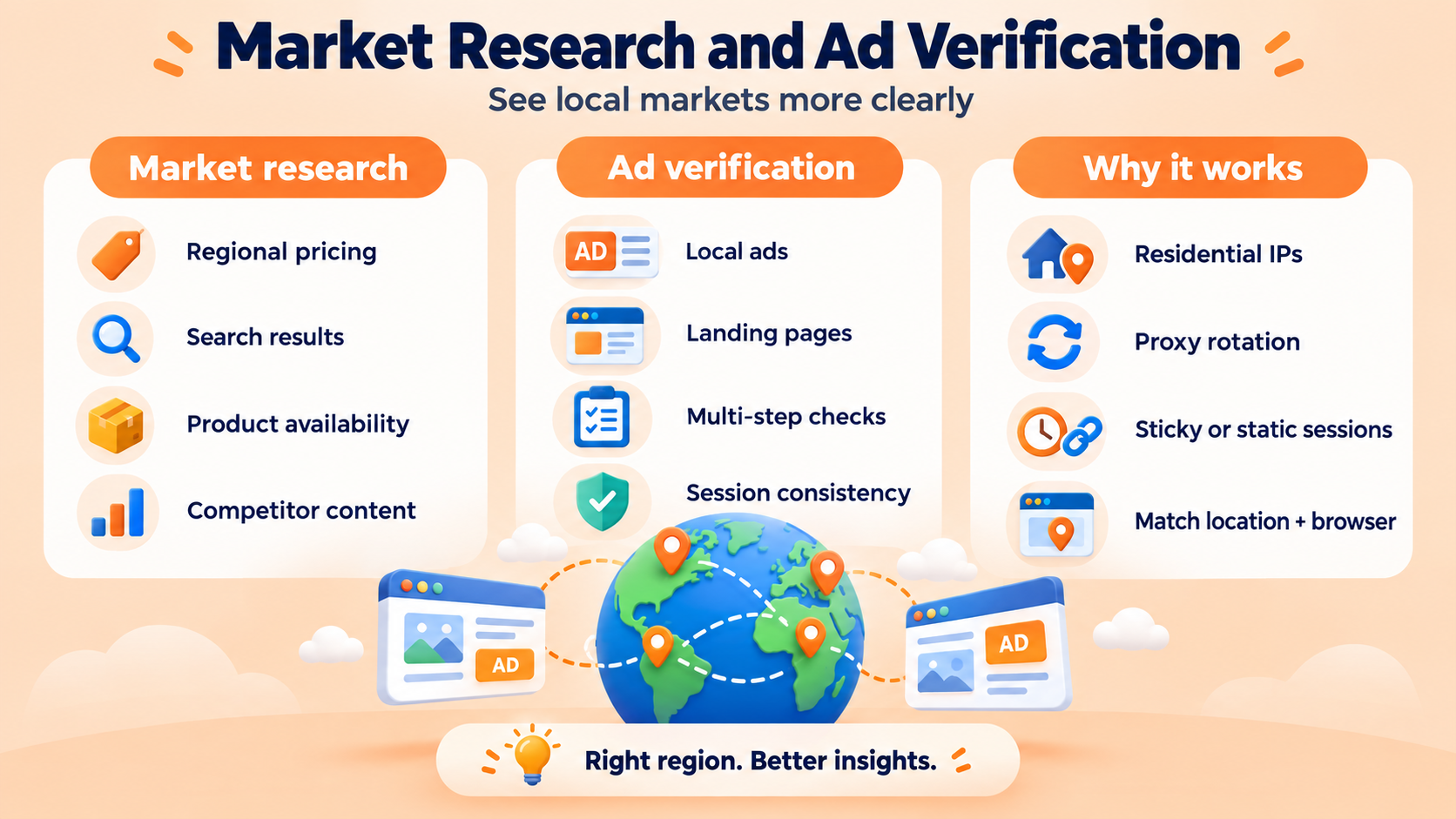
Market research teams can use residential IPs to compare regional pricing, search results, product availability, and competitor content across different locations. Proxy rotation makes it easier to scale these checks across multiple markets.
For ad verification, residential proxies help businesses check how campaigns appear in specific countries or regions. Sticky or static sessions are useful when verification requires several steps within the same browsing session.
In both cases, keeping the proxy location and browser environment reasonably aligned can create a more representative browsing setup.
Final Thoughts
Browser fingerprinting shows why changing an IP address is only one part of modern web data collection.
Rotating residential proxies are well suited to large-scale web scraping, market research, and repeated location-based checks. Static residential proxies provide greater consistency when longer sessions are required.
The most reliable approach is to treat proxy rotation, browser configuration, request frequency, and session management as parts of the same workflow. A well-designed setup can improve stability, scalability, and consistency across web scraping and ad verification tasks.






 Flux Stream Network Limited
  RM A5,7/F, ASTORIA BUILDING, NO.34 ASHLEY ROAD, TSIM SHA TSUI, HONG KONG