 Language


Why Do CAPTCHAs Appear So Quickly?
You start scraping a few pages, and suddenly a CAPTCHA appears. Requests may then slow down, return HTTP 429 errors, or become temporarily restricted.
This often happens because websites use rate limiting to control how frequently one IP can send requests. When too much activity comes from the same address within a short period, that IP may attract additional checks.
For web scraping, price monitoring, market research, SERP tracking, and ad verification, relying on a single IP can quickly become a bottleneck.
How Residential Proxy Rotation Helps
Proxy rotation spreads requests across different IP addresses rather than routing an entire scraping task through one connection. This reduces the amount of traffic associated with any single IP and gives data collection workflows more flexibility.
Rapidproxy Rotating Residential Proxies provide rotating and sticky session options for different scraping requirements. Rotating sessions are useful when many independent requests need to be distributed, while sticky sessions help maintain the same IP for a selected period.
This makes residential proxy rotation useful for large-scale web scraping, product monitoring, market research, and location-based data collection.
Rotation Works Best with Request Control
Proxy rotation should not be treated as a reason to send unlimited requests. High request volumes can still trigger server-side rate limits even when multiple IPs are available.
A more reliable approach combines proxy rotation with sensible request intervals, controlled concurrency, caching, and retry delays. When a server responds with a rate-limit signal, reducing request frequency before retrying can help avoid repeated failures.
The goal is not simply to scrape faster. It is to distribute requests efficiently and build a more stable data collection process.
Rotating vs Static Residential Proxies
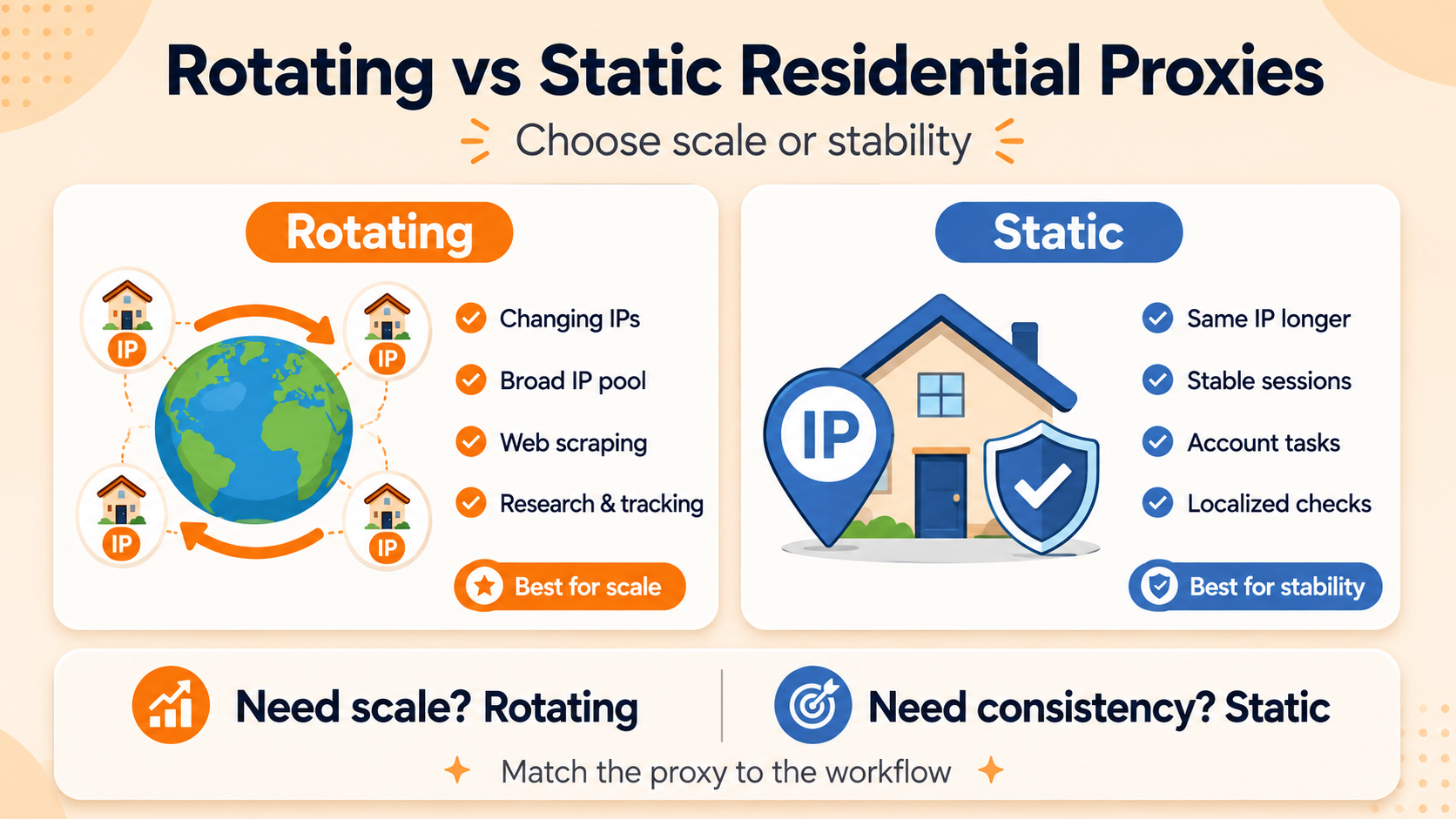
Rotating residential proxies are generally a better fit for web scraping, price tracking, market research, SERP monitoring, and ad verification where IP diversity is useful.
Some workflows need a consistent IP instead. Rapidproxy Static Residential Proxies are designed for longer-lasting connections and stable sessions, making them more suitable when frequent IP changes could interrupt a task.
Choosing between them depends on the workflow. Use rotating residential proxies when you need broader IP distribution and static residential proxies when session consistency matters more.
Build a More Reliable Scraping Workflow
Frequent CAPTCHAs and rate-limit errors often indicate that request traffic is becoming too concentrated. Simply increasing scraping speed may create more failed requests rather than better results.
Combining residential proxy rotation with request pacing, controlled retries, and appropriate session settings creates a more balanced approach. For web scraping, market research, price monitoring, and ad verification, this can improve consistency while reducing unnecessary CAPTCHA interruptions.
Rapidproxy offers both rotating and static residential proxy options, allowing businesses to choose the IP strategy that best matches their data collection needs while respecting website policies and reasonable access limits.






 Flux Stream Network Limited
  RM A5,7/F, ASTORIA BUILDING, NO.34 ASHLEY ROAD, TSIM SHA TSUI, HONG KONG