 Language


Web scraping typically fails at two layers. DOM changes break extraction logic, while rate limits, CAPTCHAs, and IP restrictions block access before parsing begins.
A resilient architecture should treat these as separate failure domains. Self-healing selectors protect the parsing layer, while residential proxy rotation keeps the network layer available.
Why Traditional Selectors Break
Most scrapers depend on fixed CSS selectors or XPath expressions. A renamed class, A/B test, or frontend redesign can break extraction even when the page still looks almost identical.
Self-healing selectors reduce this dependency by storing structural signals such as attributes, text, and surrounding DOM context. If the original selector fails, the scraper searches for the closest structural match instead of stopping.
This allows adaptive web scraping systems to absorb routine frontend changes with less manual maintenance.
Self-Healing Cannot Solve IP Blocking
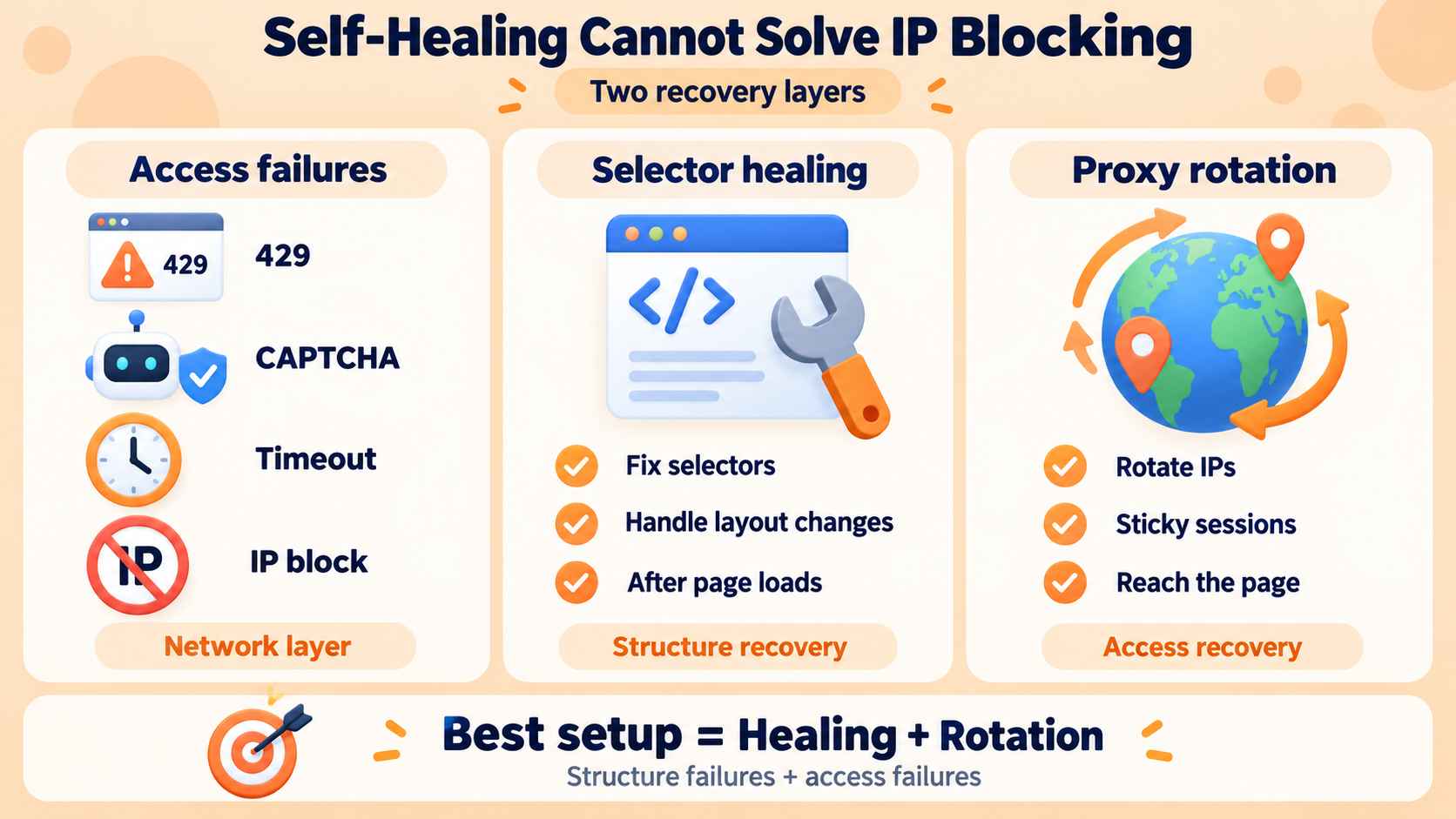
Selector recovery only matters after the page has been retrieved.
HTTP 429 responses, CAPTCHAs, timeouts, and IP restrictions occur at the network layer. Even accurate extraction logic cannot process a page the crawler cannot reach.
RapidProxy Rotating Residential Proxies provide a separate recovery layer by distributing requests across residential IPs. Proxy rotation reduces reliance on a single IP, while sticky sessions can preserve short-term continuity when needed.
The result is a dual recovery model: selector healing handles structural failures, while proxy rotation handles access failures.
Building a Double-Fault-Tolerant Pipeline
The first step is identifying why a request failed.
If the page loads but the target element is missing, the crawler should trigger selector recovery. If access fails because of throttling, blocking, or connectivity issues, the network layer should rotate the proxy, apply backoff, or create a new session.
Keeping these paths separate avoids unnecessary retries. A new IP cannot repair a broken selector, and a new selector cannot solve a blocked connection.
For large-scale web scraping, this separation also makes monitoring, debugging, and recovery much easier.
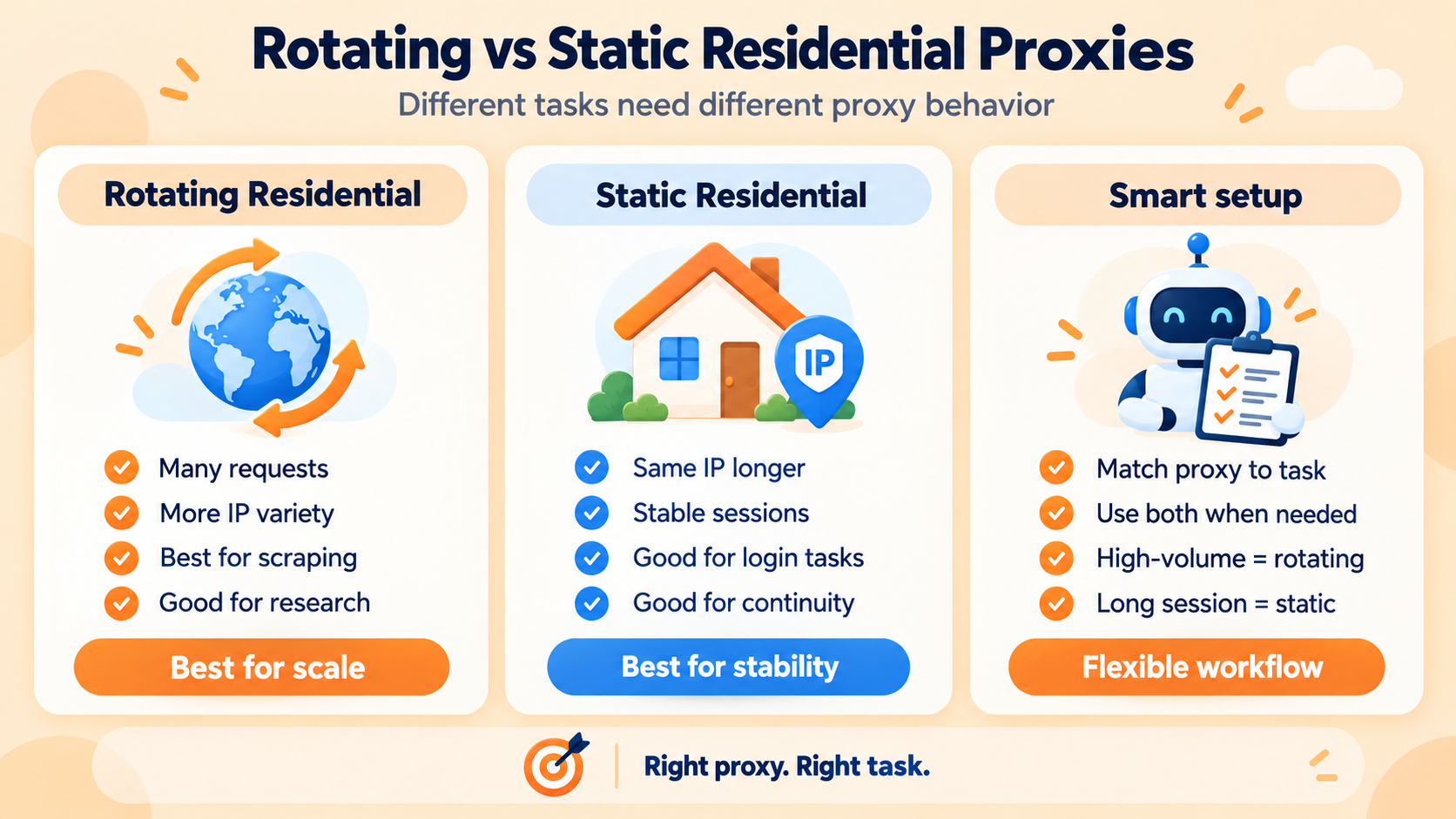
Rotating vs Static Residential Proxies
Different workloads require different proxy behavior.
Rotating residential proxies are well suited to high-volume web scraping, market research, price monitoring, and ad verification where requests are distributed across many pages or locations.
For workflows that require a stable identity, RapidProxy Static Residential Proxies maintain the same IP for longer sessions. They are better suited to login-based scraping, persistent sessions, and workflows where frequent IP changes could interrupt continuity.
A high-availability crawler can use both models and assign the right proxy strategy to each task.
Where AI Extraction Fits
Self-healing selectors and AI extraction solve different levels of change.
Self-healing works best when the crawler knows what data it needs but the DOM position has changed. AI or LLM-based extraction is more useful when the page structure changes significantly or requires semantic interpretation.
A practical pipeline uses fixed selectors first, self-healing recovery second, and AI extraction as a higher-cost fallback.
This keeps common requests fast while preserving flexibility for more complex pages.
Market Research and Ad Verification
This dual-layer architecture is especially useful for continuous data collection.
In market research, frontend changes should not silently remove competitor prices or product data. In ad verification, both regional access and changing page structures need to remain consistent.
Combining adaptive parsing with residential proxy rotation reduces both structural and network failures, improving data quality across websites and regions.
Build for Structure and Access
Reliable web scraping depends on both extraction and access.
Self-healing selectors protect the parsing layer. Proxy rotation protects the network layer. Static residential proxies add session stability when a consistent IP is required.
When the DOM changes, the parser adapts. When access fails, the proxy layer responds.
Together, these layers create a more resilient foundation for scalable web scraping, market research, price monitoring, and ad verification.




 Flux Stream Network Limited
  RM A5,7/F, ASTORIA BUILDING, NO.34 ASHLEY ROAD, TSIM SHA TSUI, HONG KONG