 Language


A UDP proxy is a server that forwards traffic using the User Datagram Protocol. It is commonly used when low latency matters more than guaranteed delivery, such as in online gaming, VoIP, DNS queries, and live streaming.
Unlike TCP, UDP does not establish a connection before sending data or wait for delivery confirmation. This keeps communication lightweight and fast, although some packets may be lost or arrive out of order.
How Does a UDP Proxy Work
A UDP proxy sits between your application and the destination server. It receives UDP packets, forwards them to the destination, and sends the response back to the client.
The basic flow is simple:
Client → UDP Proxy → Destination Server
Since the destination communicates with the proxy rather than directly with the client, the client's original IP address is not exposed to the destination.
That does not mean a UDP proxy will always improve speed. Performance still depends on factors such as proxy location, routing quality, congestion, and packet loss.
UDP Proxy vs TCP Proxy
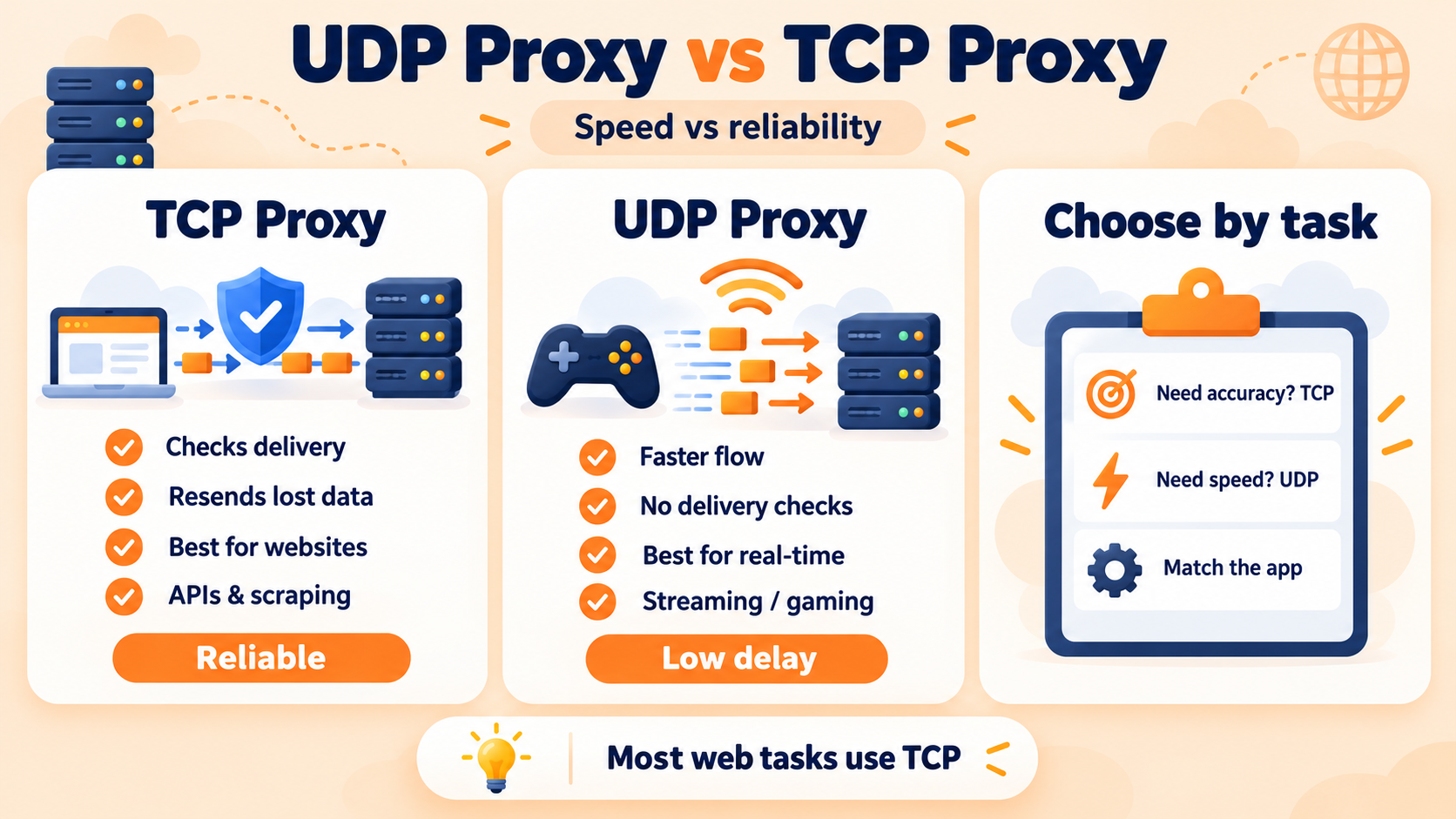
The main difference between UDP and TCP comes down to speed and reliability.
TCP checks whether packets arrive successfully and retransmits missing data. This makes it a good choice for websites, APIs, file transfers, and most web scraping tasks.
UDP avoids these extra confirmation steps. Instead, it keeps data moving continuously, which is useful for real-time applications where receiving fresh information matters more than recovering older packets.
UDP Proxy vs SOCKS5 Proxy
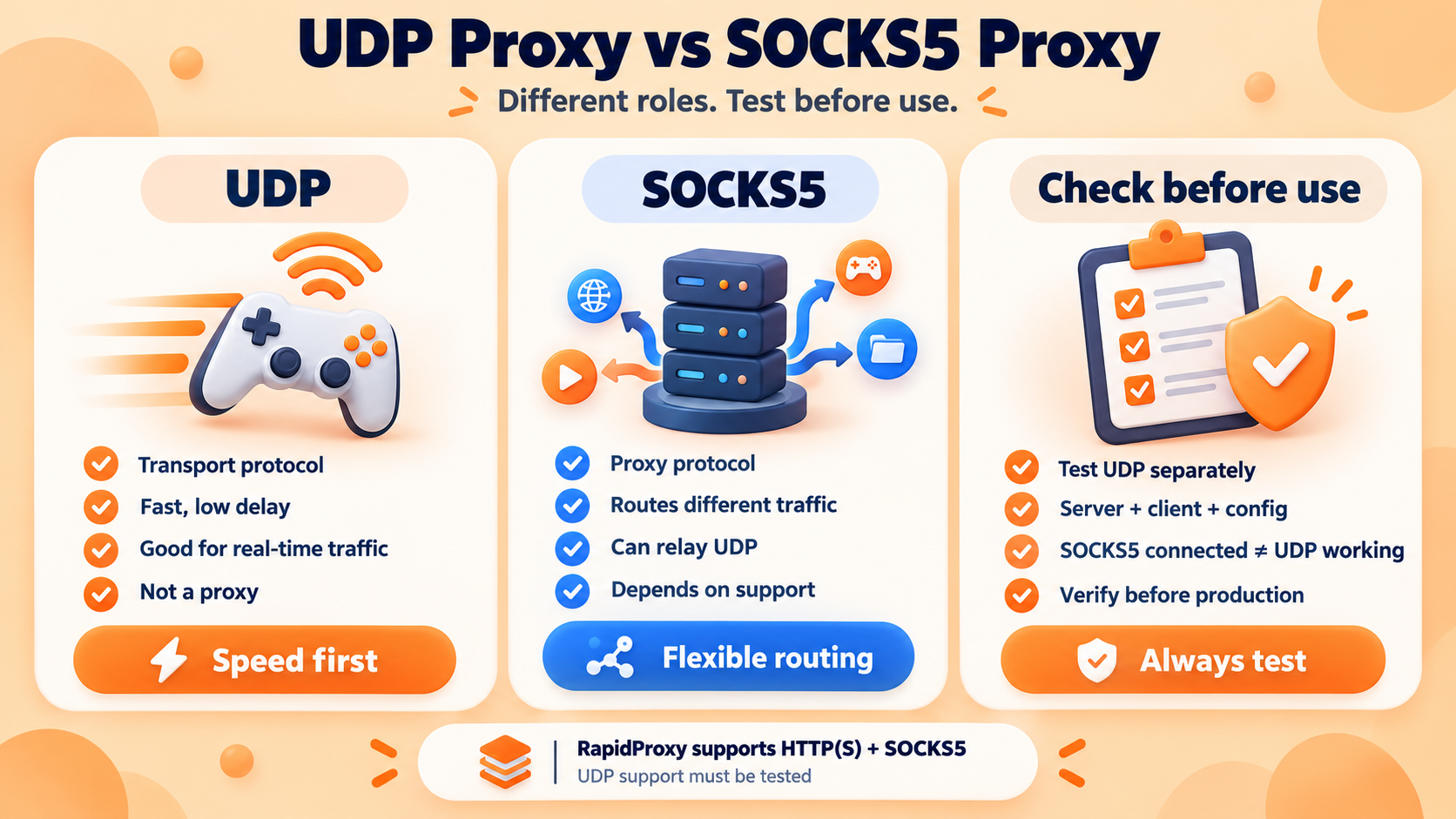
UDP and SOCKS5 are not the same type of technology.
UDP is a transport protocol, while SOCKS5 is a proxy protocol that can handle different types of traffic. SOCKS5 includes a feature called UDP ASSOCIATE, which can be used to relay UDP packets.
However, UDP support depends on the proxy server, client software, and configuration. A successful SOCKS5 connection does not automatically mean UDP traffic is being routed through the proxy.
RapidProxy supports HTTP(S) and SOCKS5 through its Residential Proxies. If your application depends on UDP, you should test the connection before using it in production.
Common UDP Proxy Use Cases
UDP proxies are mainly used in applications where fast, continuous data transmission is important.
Common use cases include:
- Online gaming
- VoIP and video calls
- DNS requests
- Live streaming
- QUIC-based applications
In these situations, stable routing and low latency are often more important than recovering every missing packet.
Does a UDP Proxy Encrypt Traffic
Not by default.
A UDP proxy can route traffic through another server and change the IP address visible to the destination, but it does not automatically encrypt the data being transmitted.
Encryption depends on the application protocol or an additional security layer. IP masking and encryption serve different purposes.
When Should You Use a UDP Proxy
A UDP proxy is a good fit when your application uses UDP and depends on low-latency communication.
For web scraping, price monitoring, SEO tracking, ad verification, and other web-based automation, HTTP(S) or SOCKS5 proxies are usually more practical.
RapidProxy's Rotating Residential Proxies support HTTP(S) and SOCKS5 and are designed for tasks that require flexible IP rotation and location targeting. For workflows that need a more persistent IP, Static Residential Proxies may be a better option.
Final Thoughts
A UDP proxy is designed for fast, connectionless traffic. It is especially useful for gaming, VoIP, DNS, streaming, and other applications where low latency matters more than perfect packet delivery.
For most web-based tasks, HTTP(S) and SOCKS5 proxies remain the more practical choice. The key is to match the proxy type to your application's traffic and confirm UDP support before relying on it.
FAQ
What is a UDP proxy?
A UDP proxy is an intermediary server that receives User Datagram Protocol packets from a client and forwards them to another destination. Responses return through the proxy before reaching the original application.
Is UDP faster than TCP?
UDP has less protocol overhead because it does not establish connections or wait for packet acknowledgements in the same way as TCP. However, using UDP does not automatically guarantee a faster end-to-end connection because routing distance, network congestion, proxy performance, and packet loss also affect speed.
Does SOCKS5 support UDP?
The SOCKS5 protocol includes a UDP relay mechanism known as UDP ASSOCIATE. Actual support still depends on the proxy server and client application, so users should verify UDP functionality before relying on it for production workloads.
Can HTTP proxies handle UDP?
Traditional HTTP proxies are intended for HTTP and HTTPS web traffic and are not general-purpose UDP relays. Applications requiring UDP should use a compatible UDP proxy or SOCKS5 implementation.
Does a UDP proxy provide encryption?
A standard UDP proxy does not automatically encrypt the contents of UDP packets. Encryption must be provided by the application protocol or another security layer.
What is a UDP proxy commonly used for?
Common use cases include multiplayer gaming, VoIP, video communication, DNS queries, live streaming, and applications that use UDP-based protocols such as QUIC.
Should I use UDP proxies for web scraping?
Usually not. Most web scraping uses HTTP or HTTPS traffic, so HTTP(S) or SOCKS5 residential proxies are generally better suited to scraping websites. RapidProxy rotating residential proxies are designed for workflows such as web scraping, price monitoring, market research, and other large-scale web data tasks.



 Flux Stream Network Limited
  RM A5,7/F, ASTORIA BUILDING, NO.34 ASHLEY ROAD, TSIM SHA TSUI, HONG KONG