 Language


Modern web scraping has evolved far beyond downloading a page and extracting a few fields. Large-scale data projects now involve URL discovery, dynamic page rendering, structured extraction, regional access, and continuous monitoring across thousands of pages. A reliable data pipeline therefore needs both an efficient extraction layer and stable access to the target websites.
Web data APIs simplify extraction by combining crawling, rendering, and structured data delivery into a single workflow. Residential proxies complement that process by providing IP diversity, geographic flexibility, and session control. Together, they create a stronger foundation for scalable web scraping, market research, price monitoring, and ad verification.
What Is a Web Data API
A web data API allows developers to collect structured information from websites without building every scraping component independently. Depending on the service, it may handle URL discovery, browser rendering, crawling, extraction, and structured output through one interface. This reduces the amount of infrastructure developers need to maintain.
The advantage becomes more noticeable as a project grows. Instead of operating separate systems for crawling, rendering, parsing, and monitoring, teams can focus on how the collected data is analyzed and used. This is particularly valuable for applications that need fresh information from many websites on a recurring basis.
However, extraction is only one part of the challenge. High-volume requests may still face rate limits, geographic restrictions, CAPTCHAs, or IP-based controls. This is why residential proxy infrastructure remains an important part of many web data workflows.
Why Residential Proxies Matter for Web Scraping
Residential proxies route requests through IP addresses associated with residential networks. They allow scraping traffic to originate from different IPs and geographic locations instead of relying on a single server address. This gives data teams more flexibility when collecting public information across multiple regions.
RapidProxy provides rotating residential proxies designed for high-volume data collection and automated workflows. Its Web Scraping solution is suitable for applications such as product monitoring, competitor research, search analysis, and regional data gathering.
For large web data projects, the main advantage is scalability. Requests can be distributed across a broader residential network while location targeting helps teams collect information from the markets that matter to them.
How Proxy Rotation Supports Large-Scale Data Collection
Proxy rotation changes the IP address used for outgoing requests according to a predefined rule. An IP can rotate between requests or remain active for a specified session before being replaced. This makes it easier to adapt the proxy behavior to different scraping workloads.
For high-volume tasks, rotating residential proxies are generally more suitable than relying on one fixed IP. RapidProxy supports rotating residential IPs as well as sticky sessions, allowing users to balance frequent IP changes with temporary session persistence.
This approach works well for price monitoring, SERP collection, product intelligence, and competitive research. Proxy rotation should still be combined with sensible request pacing, retry logic, caching, and monitoring so that the scraping system remains efficient rather than simply generating more requests.
When Static Residential Proxies Are a Better Fit
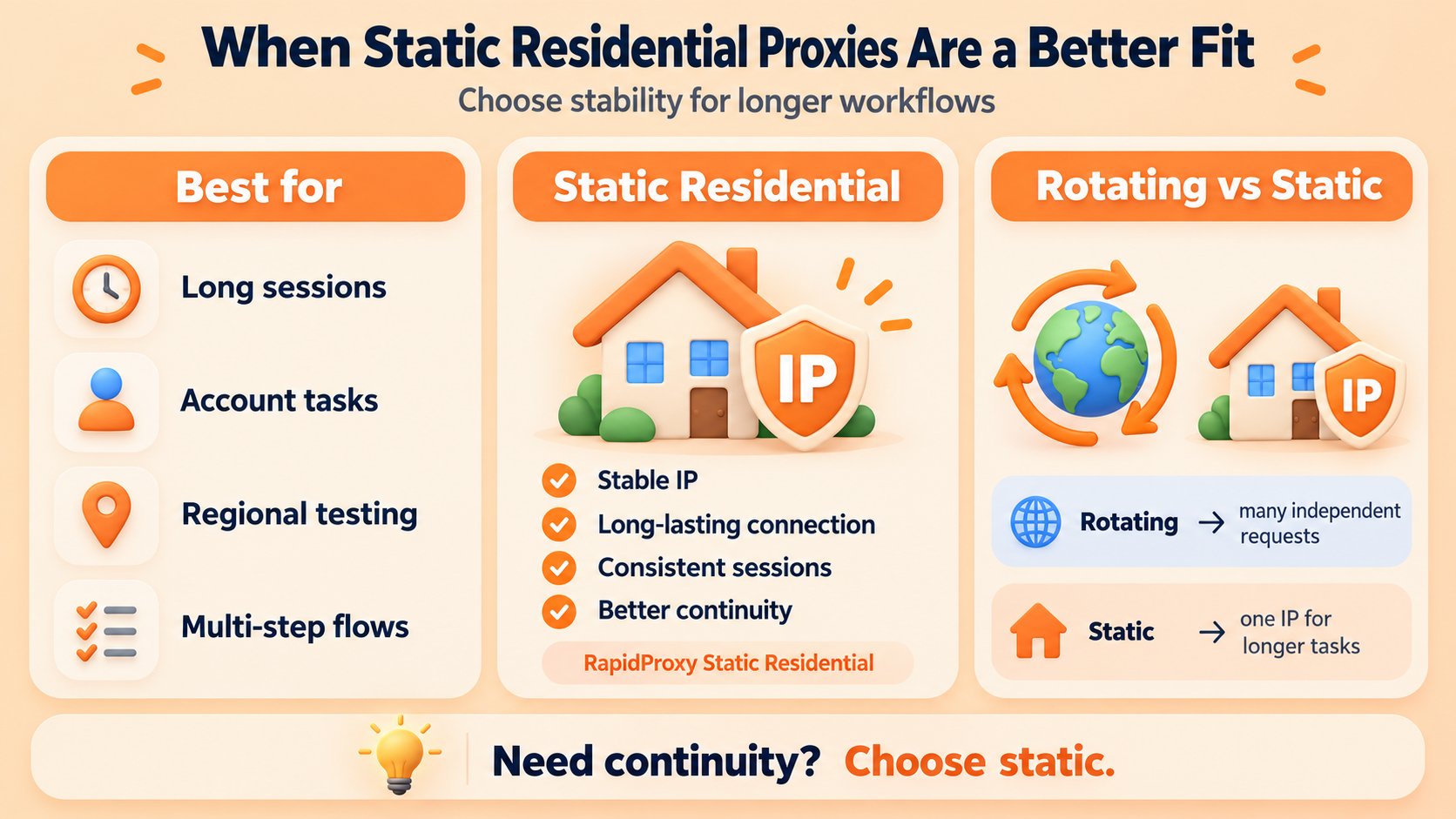
Some workflows require a stable network identity instead of frequent IP rotation. Long sessions, account-based tasks, regional testing, and multi-step workflows can become less reliable if the IP changes during the process. In these cases, a fixed residential IP is often more practical.
RapidProxy Static Residential Proxies provide dedicated residential IPs designed for long-lasting connections and stable sessions. They are suitable for workflows where connection consistency is more important than constantly changing IP addresses.
The distinction is straightforward. Rotating residential proxies are better suited to large numbers of independent requests, while static residential proxies are more useful when the same IP needs to remain available throughout a longer workflow.
Web Data APIs and Market Research
Market research increasingly depends on localized online information. Prices, inventory, promotions, search rankings, and competitor content can vary significantly between countries, regions, and cities. Collecting data from only one location may therefore give researchers an incomplete view of the market.
RapidProxy's Market Research solution supports geographically targeted data collection through residential IPs. This allows research teams to compare competitor pricing, monitor regional product availability, study local search results, and evaluate differences between markets.
Combined with a web data API, residential proxies make this process easier to automate. The API can handle crawling and extraction while the proxy layer provides the regional access needed to preserve geographic context.
Residential Proxies for Ad Verification
Online advertising is highly location-sensitive. Ads, landing pages, promotional offers, and placements can differ according to the visitor's country or city. Verification teams therefore need a reliable way to observe campaigns from the same regions as their intended audiences.
RapidProxy's Ad Verification solution supports location-based access for checking ad placement, regional campaigns, landing pages, and targeting behavior. Residential IPs allow teams to inspect how advertisements appear from different geographic markets without relying on a single testing location.
Rotating residential proxies are useful when many placements or regions need to be checked at scale. Static or sticky sessions can be more appropriate when a longer verification process requires a consistent IP.
Building a Scalable Web Data Pipeline
A reliable web data pipeline works best when extraction and access are treated as separate but connected layers. The web data API can manage discovery, rendering, crawling, and structured extraction, while residential proxies manage network identity, location, and session behavior.
Rotating residential proxies can support high-volume collection, while static residential proxies provide stability for persistent workflows. Request throttling, retry policies, caching, monitoring, and error handling can further improve reliability as data volumes increase.
The goal is not simply to send more requests. A well-designed pipeline should collect the required information efficiently while matching the right proxy strategy to each type of workload.
Final Thoughts
Web data APIs make it easier to build and scale modern extraction workflows, but reliable network access remains a critical part of the overall system. Residential proxies add the IP diversity, geographic targeting, and session flexibility required by many large-scale data projects.
Rotating residential proxies are well suited to web scraping, market research, price intelligence, and repeated regional data collection. Static Residential Proxies are a better fit when workflows require a consistent IP and longer-lasting connection.
By combining web data APIs with RapidProxy's residential proxy infrastructure, businesses can build more flexible and scalable systems for web scraping, competitive intelligence, market research, price monitoring, and ad verification.




 Flux Stream Network Limited
 RM A5,7/F, ASTORIA BUILDING, NO.34 ASHLEY ROAD, TSIM SHA TSUI, HONG KONG
