 Language


Residential proxies are widely used for web scraping, market research, price monitoring, and ad verification. The main difference between rotating and static residential proxies is simple: rotating proxies change IP addresses regularly, while static proxies keep the same IP for longer periods.
The right choice depends on whether your workflow needs broader IP coverage or stronger session stability.
What Are Rotating Residential Proxies
Rotating residential proxies automatically assign different residential IP addresses as requests are made or sessions expire. This helps distribute traffic across a larger IP pool instead of relying on one address.
They are well suited to web scraping, SEO monitoring, price tracking, and market research, especially when data must be collected across many pages or locations.
RapidProxy Rotating Residential Proxies support both IP rotation and sticky sessions, allowing the same IP to remain active temporarily when short-term continuity is needed.
What Are Static Residential Proxies
Static residential proxies use a stable residential IP that remains unchanged for longer periods. They are better suited to workflows where maintaining the same network identity is important.
Common use cases include long sessions, regional testing, account-based tasks, and multi-step workflows where an unexpected IP change could interrupt the process.
RapidProxy Static Residential Proxies are designed for users who need consistent and persistent residential IP connections.
Which Is Better for Web Scraping
Rotating residential proxies are usually the better choice for large-scale web scraping. They allow requests to move across different IPs, which is useful for collecting product data, prices, search results, and other public web information.
Static residential proxies are more useful when scraping requires several connected actions within one session. Keeping the same IP can help maintain cookies, session state, and navigation continuity.
A reliable scraping setup should also include reasonable request rates, retry logic, caching, and responsible data collection practices.
Market Research and Ad Verification
Rotating residential proxies are useful for market research because prices, promotions, inventory, and search results may vary by location. Using different residential IPs can help businesses compare markets and monitor regional changes more effectively.
They are also useful for ad verification, where ads and landing pages may differ across countries or regions. If verification requires several steps in one session, sticky sessions or static residential proxies can provide greater consistency.
Which Should You Choose
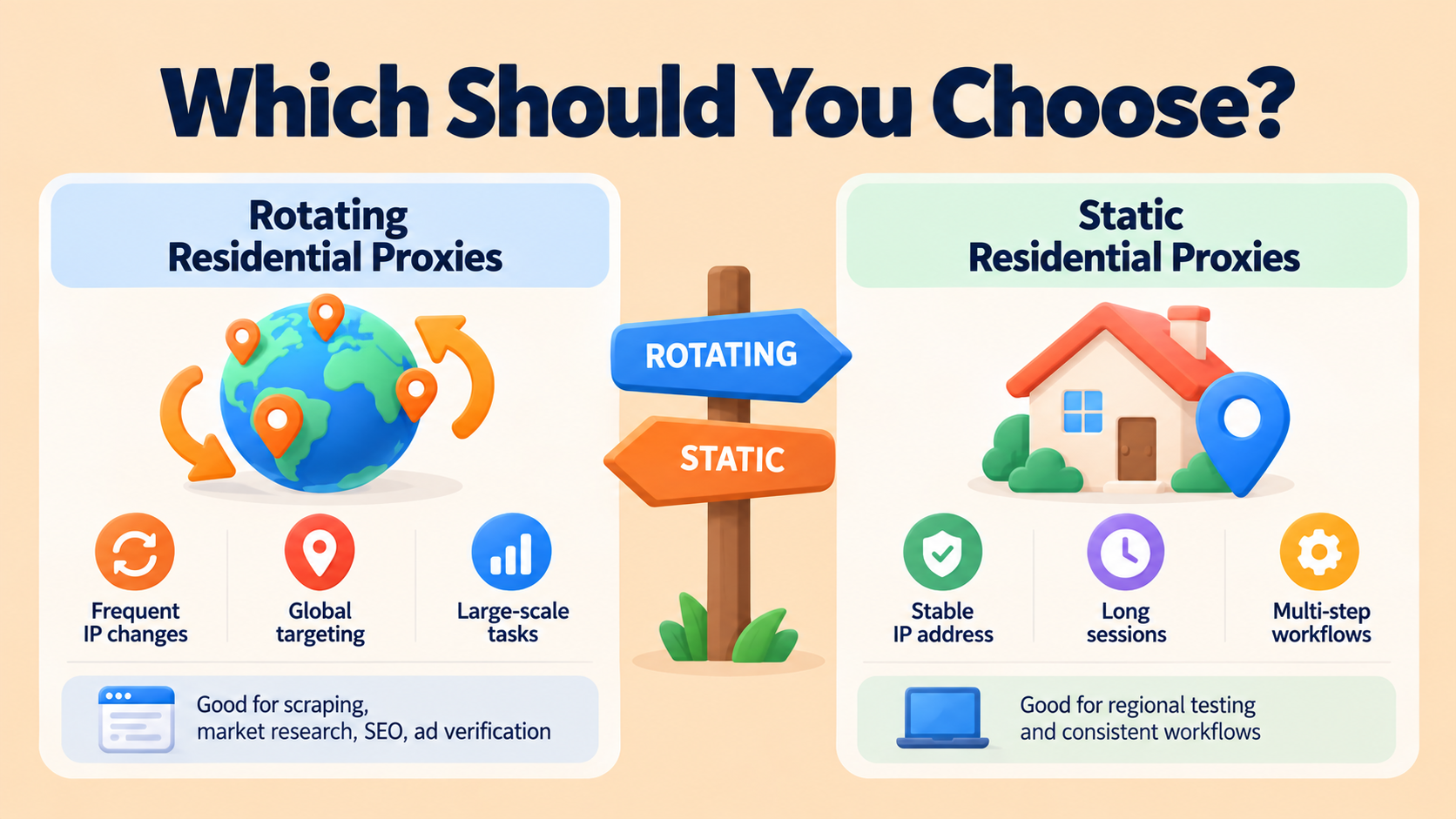
Choose rotating residential proxies when you need frequent IP changes, geographic diversity, or large-scale data collection. They are generally better for web scraping, price monitoring, market research, SEO tracking, and ad verification.
Choose static residential proxies when session stability matters more than IP diversity. They are better for long sessions, regional testing, and multi-step workflows.
Neither option is universally better. Rotating proxies are built for flexibility and scale, while static proxies are designed for consistency. The best choice depends on how your workflow handles traffic, sessions, and location requirements.




 Flux Stream Network Limited
 RM A5,7/F, ASTORIA BUILDING, NO.34 ASHLEY ROAD, TSIM SHA TSUI, HONG KONG
