 Language


A proxy server acts as an intermediary between your device and the internet. Instead of connecting directly to a website, your request passes through the proxy, so the destination sees the proxy IP rather than your original public IP.
For businesses, proxies are commonly used for web scraping, market research, ad verification, and accessing location-specific online content.
How Proxy Servers Work
Without a proxy, websites receive requests directly from your internet connection and can see your public IP address. A proxy changes this path by forwarding requests through another IP.
This gives businesses more control over IP usage, geographic access, and data collection. A proxy alone, however, does not automatically encrypt all traffic or guarantee complete anonymity.
Rotating vs Static Residential Proxies
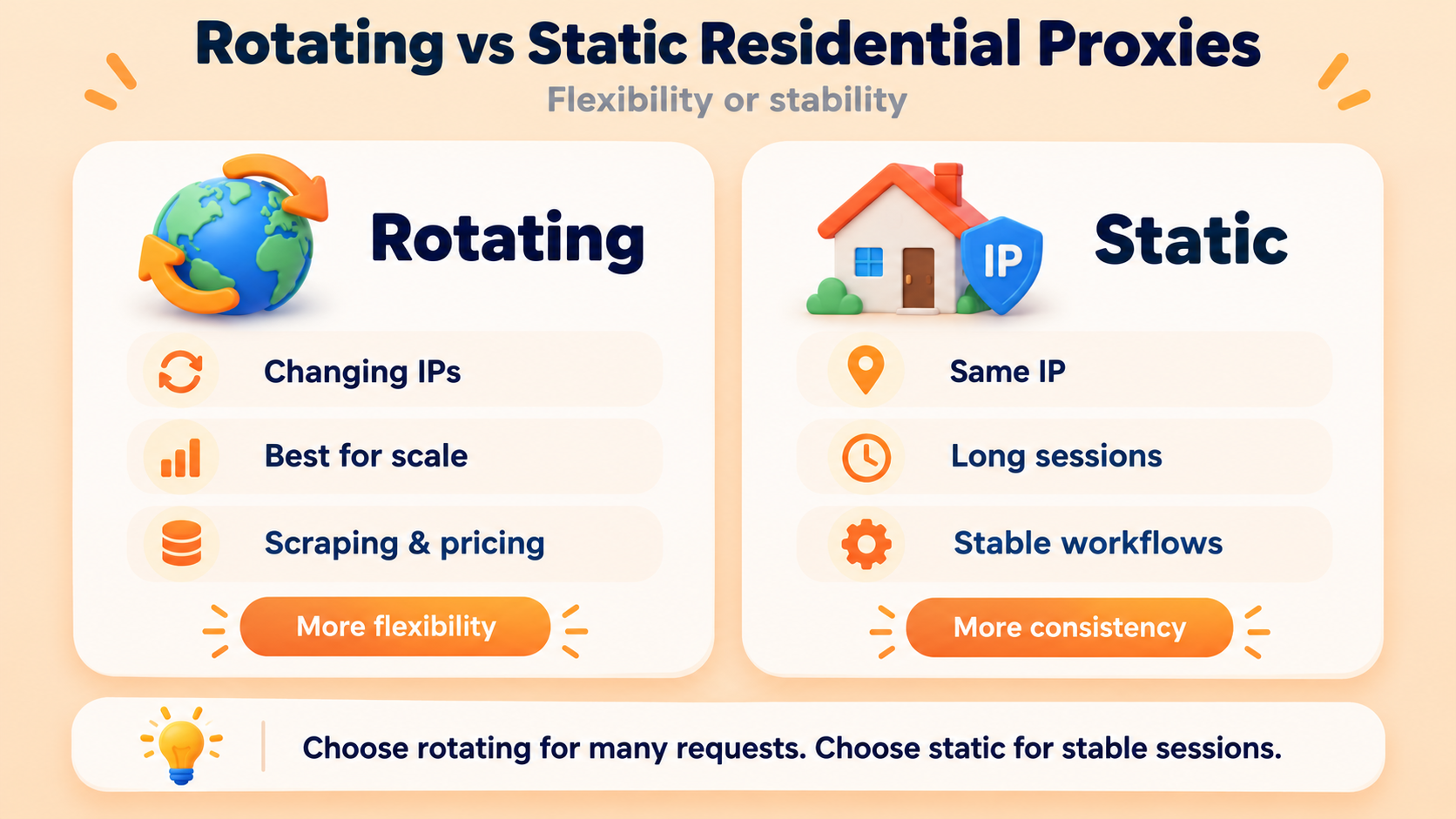
Rotating residential proxies use residential IPs that can change between requests or sessions. They are well suited to large-scale scraping, price monitoring, and other workflows that benefit from proxy rotation.
Static residential proxies maintain the same IP for longer periods, making them a better fit for persistent sessions and tasks that require a stable connection.
In simple terms, rotating proxies provide greater IP flexibility, while static residential proxies prioritize consistency.
Proxy Servers for Web Scraping
Web scraping often involves collecting public information from many pages. Sending repeated requests through one IP may result in rate limits or interrupted access.
Residential proxies help distribute requests across different IPs and locations, making data collection easier to scale. Rapidproxy's web scraping proxies can support tasks such as price tracking, product research, and competitor monitoring.
Market Research and Ad Verification
Online content can vary by location. Prices, promotions, search results, and advertisements may appear differently across countries or regions.
Rapidproxy's market research proxies help businesses access localized public information and compare regional markets. Its ad verification proxies can also help teams review how ads and landing pages appear in different target locations.
Choosing the Right Proxy
The right proxy depends on your workflow. Rotating residential proxies are ideal when IP diversity and scalable data collection are priorities, while static residential proxies are better suited to longer sessions that need a consistent IP.
Explore Rapidproxy residential proxies to find a proxy solution for web scraping, market research, ad verification, and other location-based data tasks.




 Flux Stream Network Limited
 RM A5,7/F, ASTORIA BUILDING, NO.34 ASHLEY ROAD, TSIM SHA TSUI, HONG KONG
