 Language


Bots perform useful tasks such as indexing pages, monitoring services, and supporting business integrations. Malicious bots, however, may scrape content, test stolen credentials, submit spam, generate fraudulent clicks, or overload website resources. Effective protection requires several security controls working together.
Understanding Website Bots
Bots are automated programs that interact with websites and online services. Legitimate bots include search engine crawlers, uptime monitors, and approved integrations. Harmful bots may imitate normal users, rotate IP addresses, and distribute requests across multiple devices.
Common threats include content scraping, credential stuffing, fake account creation, form spam, advertising fraud, and excessive traffic. These activities may increase infrastructure costs, affect performance, or compromise user accounts.
Use Robots.txt Correctly
A robots.txt file tells cooperative crawlers which URLs they may access. It can improve crawl management and help reduce unnecessary requests from legitimate search engines.
However, malicious bots can ignore these instructions. Sensitive pages and files should be protected with authentication and access controls rather than relying on robots.txt.
Add Risk-Based Challenges
CAPTCHA can help protect login, registration, checkout, comment, and password-reset forms. Risk-based systems such as reCAPTCHA v3 return a score that can be used to request additional verification, moderate activity, or restrict suspicious requests.
CAPTCHA should not be the only defense because sophisticated bots may bypass it. Excessive challenges may also affect accessibility and frustrate legitimate users.
Apply Rate Limiting
Rate limiting restricts how many requests a client can make within a defined period. It is especially useful for login pages, APIs, search tools, and account-recovery functions.
Avoid relying only on an IP address because legitimate users may share networks and attackers may rotate addresses. Account identifiers, sessions, request patterns, and device signals can provide additional context.
Strengthen Authentication
Use strong passwords and multifactor authentication for administrative and sensitive accounts. MFA adds another verification factor and can reduce the impact of password theft, credential stuffing, and password reuse.
HTTP Basic Authentication may provide a simple access barrier, but it is not suitable for every sensitive system. It should only be used through a secure HTTPS connection and should not replace stronger access controls.
Monitor Traffic and Update Systems
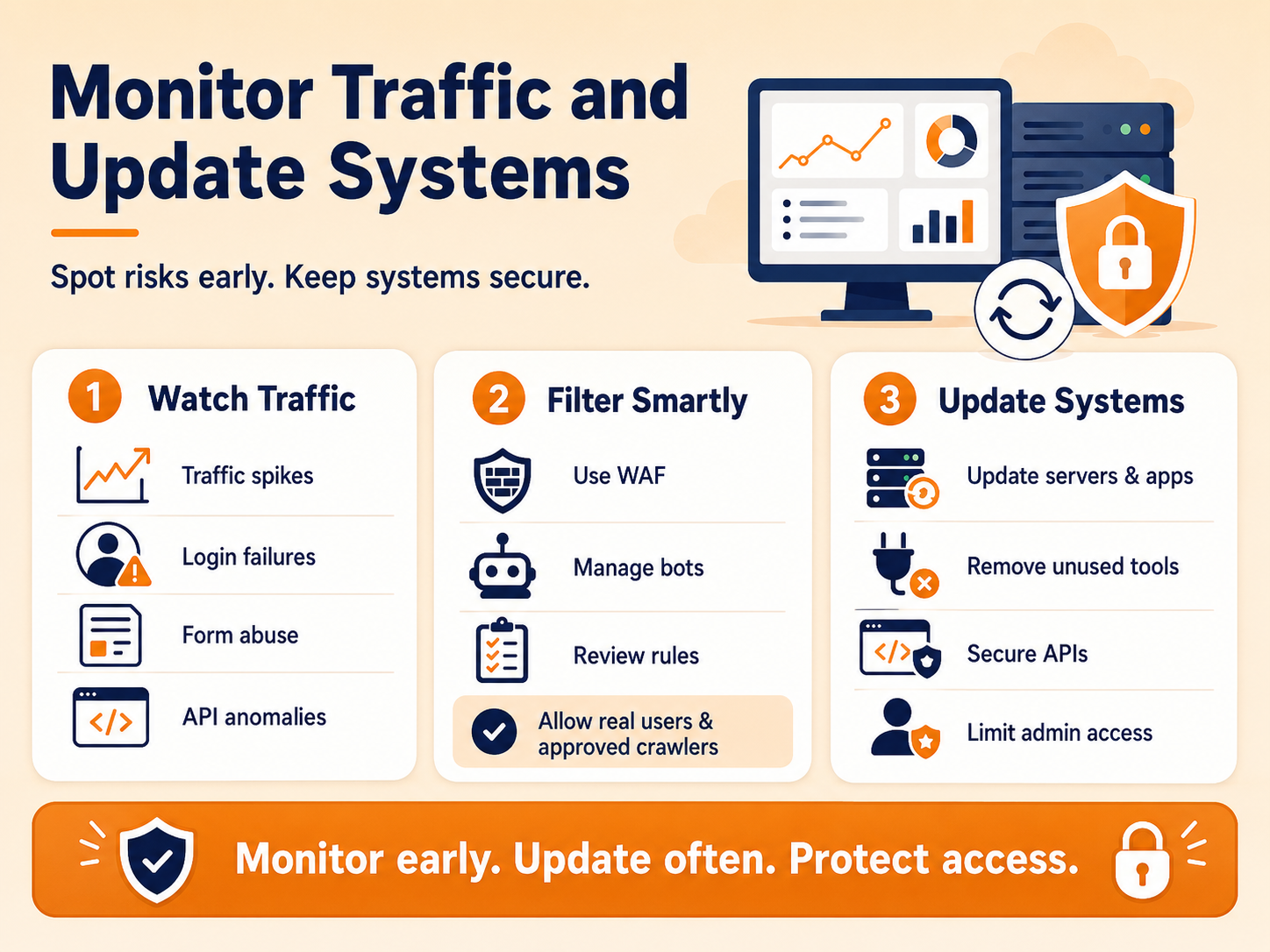
Monitor unusual traffic spikes, repeated login failures, excessive form submissions, and abnormal API activity. A web application firewall or bot-management service can help identify suspicious requests, but its rules should be reviewed to avoid blocking legitimate users and authorized crawlers.
Keep servers, content management systems, plugins, frameworks, and applications updated. Remove unused components, secure exposed APIs, and limit administrative access.
Conclusion
Malicious bots can affect website performance, account security, advertising costs, and customer trust. No single tool can stop every automated threat.
Combine crawl management, risk-based challenges, rate limiting, strong authentication, traffic monitoring, and regular security updates. Review these protections regularly as website activity and bot behavior change.





 Flux Stream Network Limited
 RM A5,7/F, ASTORIA BUILDING, NO.34 ASHLEY ROAD, TSIM SHA TSUI, HONG KONG
