


 Language


Residential proxies are widely used for web scraping, market research, ad verification, and other tasks that depend on access to localized web content. But not every project benefits from constantly changing IP addresses.
Some workflows require a consistent network identity across several requests or an extended session. In these cases, static residential proxies can provide the stability that rotating proxies are not designed to prioritize.
What Are Static Residential Proxies?
Static residential proxies use residential IP addresses that remain consistent for an extended period. They are often referred to as ISP proxies because they combine residential IP characteristics with infrastructure designed to provide stable connectivity.
Unlike a rotating proxy that periodically changes the outgoing IP, a static residential proxy keeps the same address during longer sessions. This makes it useful for workflows where an unexpected IP change could interrupt a session or affect location consistency.
Rapidproxy offers Static Residential Proxies for applications that require persistent residential IPs and long-term connections.
Static vs Rotating Residential Proxies
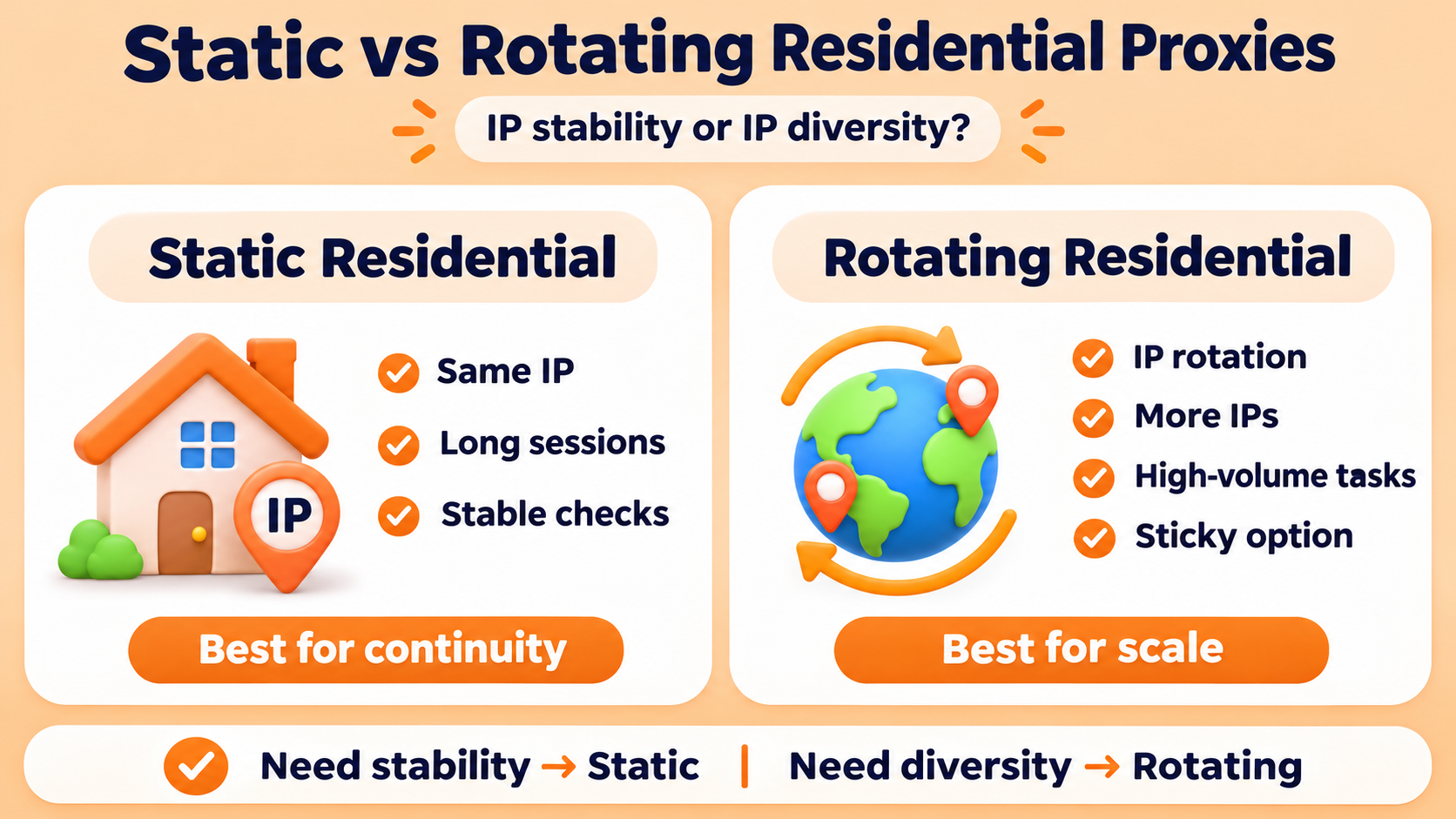
The difference between static and rotating residential proxies comes down to one question: does the workflow need IP stability or IP diversity?
Static residential proxies prioritize stability. They are useful when multiple requests need to originate from the same IP, such as repeated regional checks, longer browsing sessions, or multi-step data collection.
Rotating residential proxies prioritize diversity by switching between IP addresses from a larger residential pool. This approach is often better for high-volume web scraping, price monitoring, SERP collection, and other tasks involving many independent requests.
Rapidproxy's Rotating Residential Proxies support both IP rotation and sticky sessions, allowing businesses to adjust session behavior according to the task.
Static Residential Proxies for Web Scraping
Proxy rotation is often the preferred approach for large-scale web scraping because requests can be distributed across different residential IPs. However, frequent rotation is not ideal for every scraper.
Some scraping workflows involve several related requests. A crawler may need to move through multiple pages, preserve a session, or repeatedly monitor the same localized source. Keeping the same residential IP can make these workflows more consistent.
A scalable scraping setup may therefore use both proxy types. Rotating proxies can handle large numbers of independent requests, while static residential proxies can handle session-sensitive parts of the workflow.
Market Research and Price Monitoring
Online markets are increasingly localized. Prices, promotions, product availability, search results, and competitor content can vary depending on where a visitor appears to be located.
Static residential proxies can help researchers maintain a consistent regional IP while observing these changes over time. Instead of changing the network identity with every request, the same location can be used throughout a research session.
For broader market research covering many countries or thousands of pages, rotating residential proxies may provide greater scalability. Static proxies are better suited to focused research where consistency matters.
Ad Verification and Regional Monitoring
Location also plays an important role in digital advertising. Ads, promotions, and landing pages may differ by region, making it necessary to check how campaigns appear in different markets.
Static residential proxies are useful when several verification steps need to be completed from the same regional IP. Rotating proxies are more appropriate when many locations or placements need to be checked at scale.
The same approach can support localized SEO monitoring, website testing, and regional content analysis.
Why Proxy Rotation Still Matters
Using a static residential proxy does not mean proxy rotation is unnecessary.
Sending a very large number of requests through one IP can make high-volume data collection inefficient. Rotating residential proxies distribute requests across multiple IP addresses, making them more suitable for workflows where scale matters more than maintaining one persistent identity.
The most effective proxy strategy is often a combination of both approaches. Use rotation where diversity is valuable and static IPs where continuity is required.
Choosing the Right Residential Proxy
The right residential proxy depends on how the application behaves.
If the project involves thousands of independent requests across multiple locations, rotating residential proxies usually provide more flexibility. If the project requires a stable IP throughout a longer session, static residential proxies are generally the more suitable option.
Instead of asking which proxy type is better overall, focus on whether the workflow benefits more from a consistent IP or frequent IP rotation.
Final Thoughts
Static residential proxies fill an important gap between residential access and long-term IP stability. They are particularly useful for session-sensitive web scraping, focused market research, regional monitoring, and ad verification.
Rotating residential proxies remain the stronger option for high-volume data collection and workflows that benefit from greater IP diversity.
By matching the proxy type to the session requirements of each task, businesses can build more reliable and efficient web data workflows.




 Flux Stream Network Limited
 RM A5,7/F, ASTORIA BUILDING, NO.34 ASHLEY ROAD, TSIM SHA TSUI, HONG KONG
