


 Language


Google Search data can help businesses understand keyword visibility, competitor activity, and differences between regional markets. For SEO teams, ecommerce companies, and market researchers, comparing search information across locations can reveal opportunities that are easy to miss when research is limited to one market.
Collecting regional data consistently requires more than simply sending requests from the same connection. Location, session behavior, and IP strategy can all influence how a data collection workflow performs. Residential proxies provide a practical way to manage these variables for permitted web scraping and market research.
Why Google Search Data Matters for Market Research
Search results can reflect differences in language, competition, commercial intent, and regional demand. A product category performing strongly in the United States may face different competitors or search behavior in the United Kingdom, Germany, or another market.
For businesses planning international expansion, this information can support keyword research, competitor analysis, content localization, and campaign planning. Tracking regional visibility over time can also help teams understand where competitors are gaining or losing exposure.
The value comes from comparing equivalent data across markets rather than treating search behavior as globally uniform.
Using Residential Proxies for Regional Research
Residential proxies route requests through residential IP addresses, making them useful when research depends on geographic context. Instead of conducting every check through one location, teams can work with IPs associated with the markets they need to study.
For larger research projects, Rapidproxy Rotating Residential Proxies can support workflows that require IP rotation or temporary session continuity. This makes them suitable for regional web scraping, competitor monitoring, price research, and other data collection tasks involving multiple locations or large numbers of independent requests.
A reliable workflow should also include reasonable request rates, retry handling, session management, and data validation. Proxy infrastructure can support the collection process, but data quality still depends on how the overall system is designed.
How Proxy Rotation Fits Web Scraping
Proxy rotation changes the IP used during a data collection workflow. Instead of routing every request through one address, requests can be distributed across a broader residential proxy pool.
This is particularly useful for projects that involve many independent pages, keywords, or geographic markets. A research team comparing several markets, for example, may use different residential IPs for separate collection sessions while keeping the location of each dataset clearly defined.
Not every request needs a new IP. When several related pages belong to the same session, maintaining one IP temporarily can provide better continuity. The rotation strategy should therefore follow the structure of the research rather than use a fixed rule for every task.
When Static Residential Proxies Are Better
Some workflows require consistency rather than frequent IP changes. Repeated regional checks, longer sessions, and multi-step testing can be easier to compare when the same residential IP remains available throughout the process.
Rapidproxy Static Residential Proxies are a better fit when a persistent IP is important. For example, a marketing team could check the same regional landing page before and after an update while keeping the network location consistent.
This makes it easier to determine whether changes in content, pricing, language, or redirects come from the website itself rather than from a different network identity.
Residential Proxies for Ad Verification
Ad verification is another use case where geographic context matters. Global campaigns may display different ads, landing pages, currencies, or promotions depending on the visitor's location.
Residential proxies can help marketing teams review these experiences from relevant markets. Rotating proxies are useful when many locations need to be checked, while static residential proxies are better suited to repeated verification from the same network environment.
For example, a brand running campaigns in several countries may want to confirm that each market receives the correct landing page and localized offer. Consistent regional testing makes these issues easier to identify before they affect campaign performance.
Choosing the Right Proxy Strategy
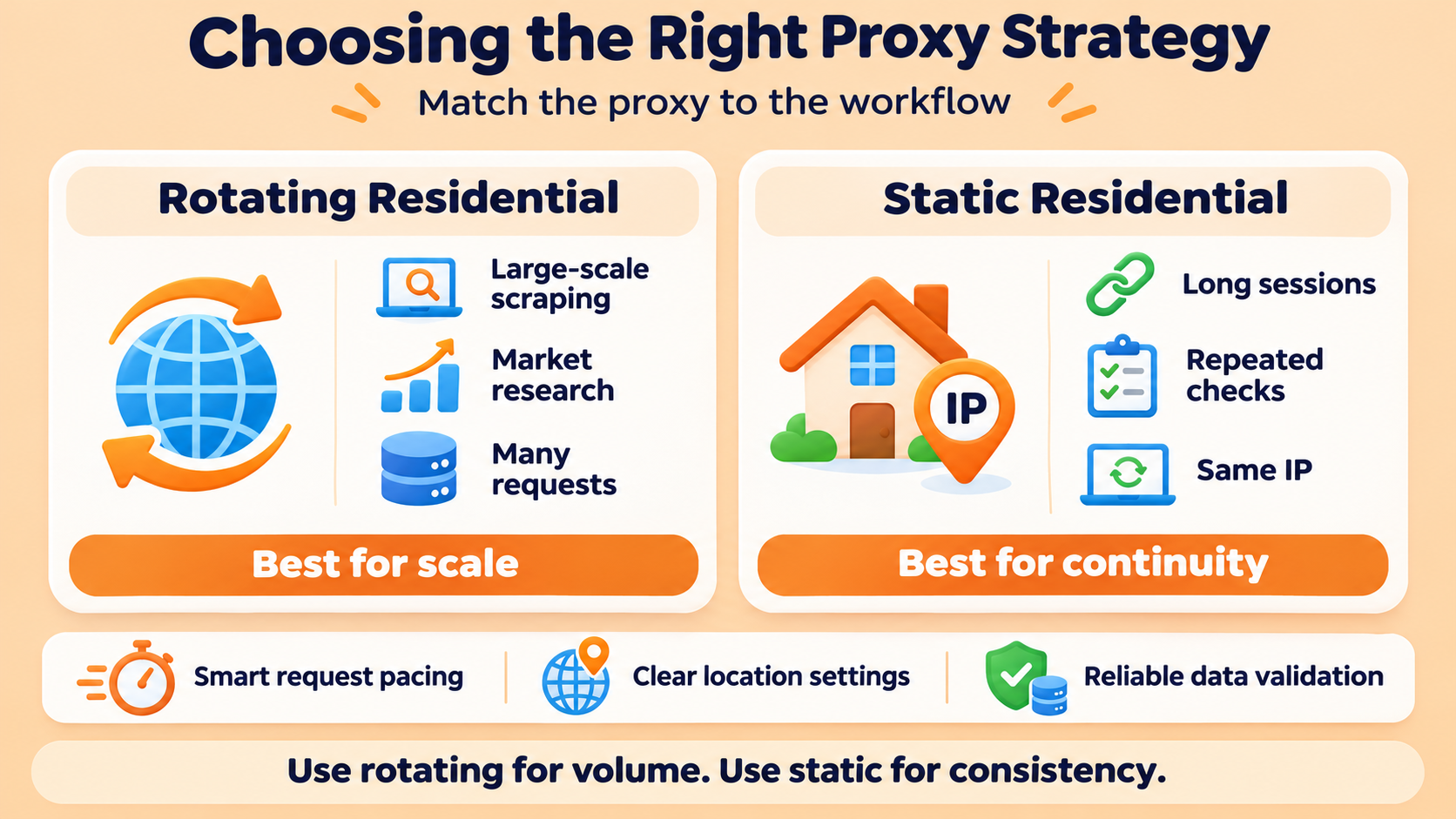
The right proxy type depends on how the data will be collected. Rotating residential proxies are generally better suited to large-scale web scraping, market research, and projects involving many independent requests. Static residential proxies are more appropriate when longer sessions or repeated checks require a consistent IP.
For Google Search data collection and other regional research projects, proxy selection should be combined with sensible request management, clear location settings, and reliable data validation. A well-designed workflow helps businesses collect more consistent regional information while keeping the research process manageable and focused on data quality.



 Flux Stream Network Limited
 RM A5,7/F, ASTORIA BUILDING, NO.34 ASHLEY ROAD, TSIM SHA TSUI, HONG KONG
