


 Language


Large-scale web scraping often requires more than sending requests from a single IP address. As request volume increases, relying on one connection can lead to rate limits, CAPTCHA challenges, or inconsistent access to location-specific content.
Rotating residential proxies address this problem by distributing requests across residential IP addresses. For businesses collecting public web data, they can provide the IP diversity and geographic flexibility needed for web scraping, market research, price monitoring, and ad verification.
What Are Rotating Residential Proxies
Rotating residential proxies route requests through IP addresses associated with residential networks. Instead of keeping the same IP indefinitely, the proxy automatically changes the outgoing address according to the selected rotation or session settings.
This makes them useful for workflows involving many independent requests. Rather than manually replacing IP addresses, businesses can use a residential proxy pool to distribute traffic across different connections.
RapidProxy Rotating Residential Proxies support automatic IP rotation as well as sticky sessions, giving users more control over how long an IP remains active during a workflow.
Why Proxy Rotation Helps Web Scraping
A scraper collecting prices, product listings, search results, or other public information may need to send thousands of requests. Sending all of them through one IP concentrates activity on a single network identity.
Proxy rotation distributes those requests across different residential IPs. This reduces reliance on any individual address and makes it easier to scale data collection across multiple pages, websites, or geographic markets.
However, rotation should not be treated as the only factor in a reliable scraping setup. Request pacing, retry logic, concurrency limits, caching, and data validation are also important. The most effective approach combines appropriate proxy rotation with responsible request management.
Market Research Across Multiple Locations
Online markets are rarely identical across regions. Prices, promotions, inventory, search results, and product availability may differ between countries or cities.
Residential proxies allow research teams to access localized public content from different locations. When combined with IP rotation, businesses can collect broader datasets without depending on one regional connection.
This is especially useful for competitive research, ecommerce intelligence, price monitoring, and product availability analysis. Instead of relying on a single market view, researchers can compare how websites and offers change across locations.
Ad Verification with Residential Proxies
Digital advertising is also highly location-dependent. Advertisements, landing pages, promotions, and creative assets can vary depending on where a visitor appears to be located.
Rotating residential proxies allow advertising teams to check campaign delivery from different residential IP locations. This can support ad placement verification, localized landing-page testing, campaign monitoring, and regional quality checks.
For large verification projects covering many markets, IP rotation provides greater flexibility than repeatedly using one fixed address.
Rotating vs Static Residential Proxies
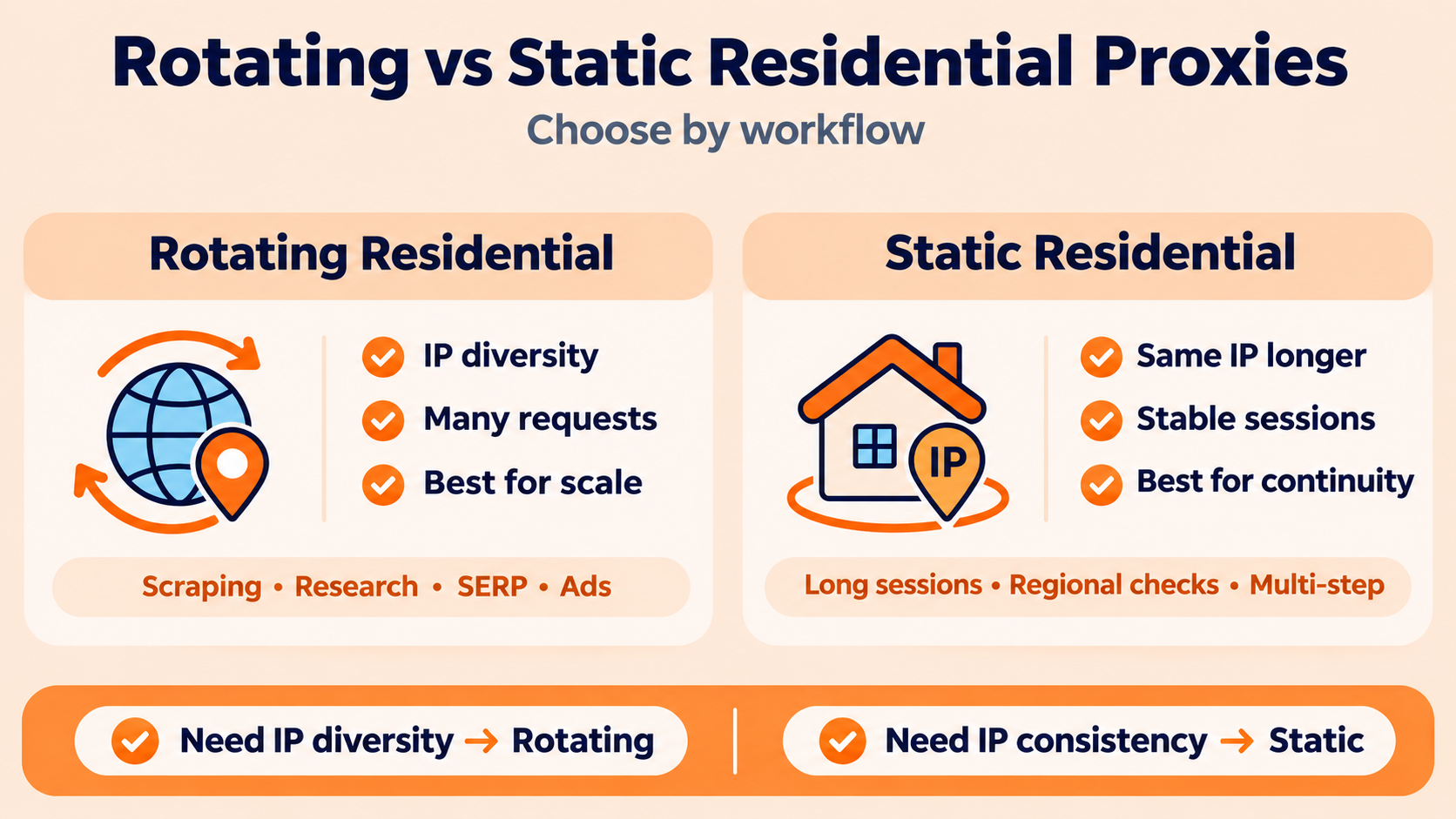
Rotating residential proxies are not automatically better for every task. The right choice depends on whether the workflow needs IP diversity or IP consistency.
Rotating proxies are usually better suited to high-volume web scraping, market research, price tracking, SERP monitoring, and large-scale ad verification. These workflows often involve many independent requests where changing IP addresses is useful.
Static residential proxies are designed for situations where the same IP needs to remain available for longer. Long sessions, repeated regional checks, and multi-step workflows may benefit from a persistent network identity.
For these scenarios, RapidProxy Static Residential Proxies provide stable residential IPs for workflows where connection consistency is more important than frequent rotation.
Choosing the Right Proxy Rotation Strategy
The best rotation frequency depends on the task. Some scraping jobs consist of independent requests and can rotate IPs frequently. Others need several related requests to remain within the same session.
Frequent rotation works well when IP diversity is the priority. Sticky sessions are more useful when a temporary consistent identity is required, such as browsing several related pages during the same data collection process.
The goal is not to rotate as often as possible. It is to match the session behavior to the structure of the workflow.
Why Residential Proxies Fit Data-Driven Workflows
Residential proxies are particularly useful for projects where location and IP diversity affect the information being collected. They allow businesses to access public web content through residential network connections while adapting proxy behavior to different research requirements.
Rotating residential proxies provide greater flexibility for large-scale collection, while static residential proxies provide stability for longer sessions. Using each type where it fits best can create a more reliable and efficient proxy infrastructure.
Final Thoughts
Rotating residential proxies are a strong option for web scraping when a project requires scale, geographic flexibility, and access to multiple IP addresses. They are also well suited to market research, price monitoring, search analysis, and ad verification.
Static residential proxies remain the better choice when consistent sessions or persistent IP addresses are required. Instead of treating one proxy type as universally superior, businesses should choose based on how their data collection workflow actually operates.
For large-scale projects built around independent requests and multiple locations, rotating residential proxies are usually the most practical starting point.




 Flux Stream Network Limited
 RM A5,7/F, ASTORIA BUILDING, NO.34 ASHLEY ROAD, TSIM SHA TSUI, HONG KONG
